Burnout affects over 50% of entrepreneurs. Learn the real warning signs, why passionate business owners are most at risk, and 5 practical ways to prevent it.
Working 60-hour weeks, raising three young kids, completing a PhD, and training 10 to 15 hours a week for adventure racing. Sound unsustainable? It is. But for many business owners, that is just Tuesday.
Burnout is one of the most talked about yet least acted upon challenges in the entrepreneurial world. Over 50% of entrepreneurs experience burnout at some point in their careers. And the most dangerous part is that the people most at risk are often the ones who love what they do most.
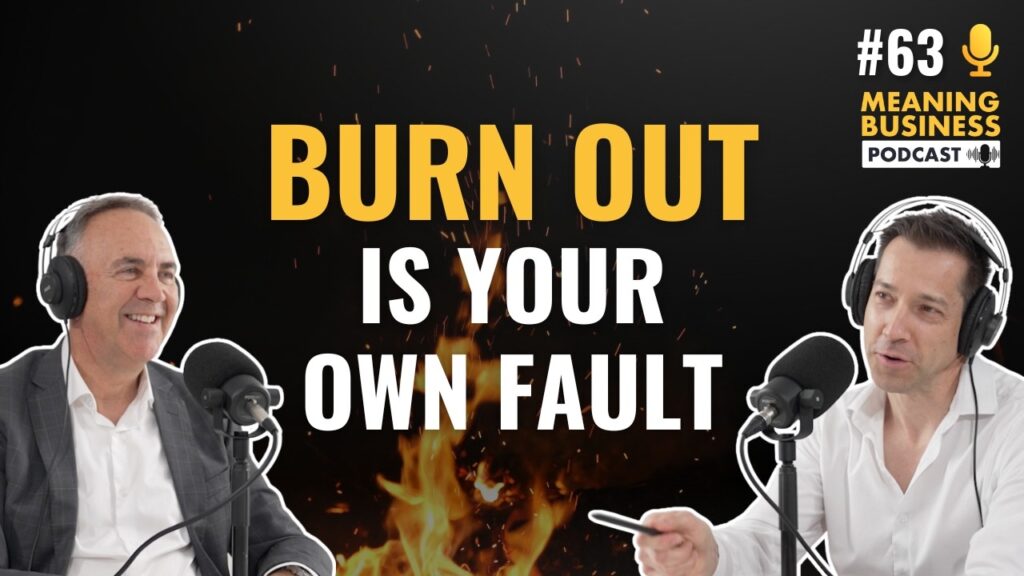
In this episode of the Meaning Business Podcast, Peter Spinda and Bruce Coudrey get candid about their own experiences with burnout, what the real warning signs look like, and the five practical strategies that can help you manage it before it manages you.
Why Passionate Business Owners Burn Out the Hardest
There is a useful distinction worth making early in this conversation. If you hate what you are doing, that is stress. If you love what you are doing, that is passion. The problem is that passion does not protect you from exhaustion. It just makes the warning signs harder to see.
The typical entrepreneur grabs a challenge by the horns and runs with it. Multiple projects, multiple commitments, multiple balls in the air at once. The energy is there. The drive is real. So you keep going. And going. And going.
Until one day you find yourself sitting in a doctor’s office, certain something is wrong with your blood work, only to be told your results are completely clear. The doctor asks a few questions about your life. You rattle off your workload, your family commitments, your study schedule, your training routine. The doctor pauses. And then asks the question you were not expecting: do you think you might be suffering from burnout?
That is how it often goes. Not a sudden collapse. A gradual accumulation that you do not notice until you are already in it.
The Burnout Paradox: Success Can Be Just as Draining as Struggle
Most people associate burnout with overwhelm and failure. But burnout can also come from rapid success.
When a business goes from zero to hero, when the team doubles in size, when customers are flooding in and every week brings a new set of problems to solve, the energy that comes from momentum can mask how depleted you actually are. You are energised by what is happening, but you are being drained just as fast.
The same applies to anyone who has fought their way through difficulty multiple times. Early in a business, challenges come with motivation and resilience. You push through because that is what you do. But when the same challenges repeat often enough, the mindset shifts. The same situation that once fired you up can start to feel crushing.
Burnout is not weakness. It is what happens when passion, effort, and output run ahead of recovery for too long.
The Number One Warning Sign of Burnout Most People Miss
There are many symptoms of burnout: fatigue that does not improve with rest, loss of enthusiasm, difficulty concentrating, irritability, cutting corners. But according to Peter, there is one underlying signal that matters more than any other.
A change in personality.
When someone who has always been upbeat, positive, and engaged starts becoming withdrawn, negative, or moody, that is not just a bad attitude. That is a brain saying it has had enough.
It does not happen overnight. It creeps in gradually. The bubbly person becomes quieter. The optimist starts seeing everything through a pessimistic lens. The sharp, detail-oriented professional starts making careless mistakes because they have simply stopped caring.
In a real client example, one business owner was becoming progressively grumpier while his partner was producing increasingly sloppy work. Neither would have flagged it as burnout. But both were showing textbook signs of a brain and body that had hit their limit.
If you are noticing a shift in yourself or someone close to you, do not dismiss it. That shift is the signal.
5 Practical Strategies to Manage and Prevent Burnout
1. Recognise It Early
Burnout prevention starts with self-awareness. Take some time to reflect on past experiences: when have you burned out before, what were your personal warning signs, and what led you there? Everyone’s body and mind respond differently. Learning your own patterns means you can catch the early signals before they escalate.
2. Set Workload Boundaries and Build in Recovery
Be realistic about what you can sustain. Working long hours is not the problem in isolation. The problem is working long hours without recovery, without limits, and without communicating those limits to the people around you.
Set boundaries with your team and your clients. If you have built an expectation that you are available at any hour, on any day, you have created a pattern that will drain you over time. Protecting your recovery is not a luxury. It is a performance strategy.
3. Build for Control, Autonomy, and Meaning
One of the most effective ways to reduce burnout is to build a business that does not entirely depend on you. Put systems and controls in place so that operations can run without your constant involvement. Give your team genuine autonomy so they can do their jobs without needing to escalate everything.
And know your why. What is the purpose driving everything you are doing? Without a meaningful goal to move toward, the daily grind becomes exactly that. Having a clear reason for the work you are doing is fuel. It is what turns effort into something worth sustaining.
4. Systemise, Do Not Just Rely on Resilience
Systems reduce the mental load. When things are left to chance, you carry the cognitive weight of uncertainty. When processes are in place, you are freed to focus on what matters most.
As one of Peter’s advisers once put it: stress and lack of time are almost always the result of insufficient preparation, not insufficient hours. The systems you build today are what give you the time and clarity you need tomorrow.
5. Build Sustainable Performance Habits
This is the long game. Whatever helps you reset, recharge, and refocus, turn it into a regular habit. For some it is an annual business review during the quiet period between Christmas and New Year. For others it is a morning routine, a weekly walk, or attending a conference outside their usual industry.
Sharpening the axe is not a metaphor. Two people cutting down trees. One stops to sharpen the axe. The other keeps going. By the end of the day, the one who stopped has cut down more. Taking time to step back, reflect, and recharge does not slow you down. It is what makes you more effective when you return.
The Power of Having Something to Look Forward To
One of the most underrated burnout prevention tools is simply having a goal on the horizon.
Scheduling holidays in advance gives you something to push toward. It creates a finish line. And there is something deeply satisfying about earning a break, arriving at it genuinely exhausted, knowing you gave everything to get there, and then truly resting because you know you deserve it.
The same applies to annual planning. Reviewing the year, setting targets, and mapping the path ahead transforms the holiday period from a passive break into an active recharge. You come back with direction, not just rest.
Not All Breaks Are the Same
A holiday sitting by a pool is very different from a holiday tearing across Europe from city to city. Both have their place. But breaks do not have to mean travel at all.
Attending a conference outside your industry, reading a book that has nothing to do with your work, going to a sporting event, or simply disrupting your usual routine can all re-energise your thinking. Peter attended a Football Queensland conference expecting little and walked away with insights he immediately applied to his business. Sharpening the axe can happen anywhere.
The key is intentional disconnection from the daily grind, even briefly, on a regular basis.
What the Best Business Owners Have in Common
The most resilient, high-performing business owners Peter and Bruce have worked with share a consistent trait. They take time to sharpen the axe. They step back, reflect, review, and return with clarity. They do not wait until they are running on empty. They treat recovery as part of the strategy, not a reward for surviving.
That is the mindset shift that separates sustainable high performance from boom and bust cycles.
The Bottom Line on Burnout
Burnout is not a sign of failure. It is a sign that you have been giving a lot, possibly too much, for too long without adequate recovery. The good news is it is manageable and largely preventable if you take it seriously.
Recognise the early warning signs. Set real boundaries. Build systems that support you. Know your why. And make rest a habit, not an afterthought.
At Benchmark Business Advisory, we work with business owners who are building sustainable, valuable businesses without sacrificing their health or quality of life in the process. If you want a confidential conversation about where your business is and how to build it smarter, book a free discovery call with our team.
Key Takeaways
Burnout affects over 50% of entrepreneurs and is most common among high achievers who love their work. The biggest warning sign is a personality change, not just tiredness. Passion does not protect you from exhaustion. Both struggle and rapid success can lead to burnout. The five key strategies are: recognise it early, set boundaries, build for autonomy and meaning, systemise your business, and create sustainable performance habits. Having clear goals and scheduled breaks dramatically reduces burnout risk. Sharpening the axe is not lost time. It is what makes you more effective.
This article is based on Episode 63 of the Meaning Business Podcast, hosted by Peter Spinda and Bruce Coudrey of Benchmark Business Advisory.