If you want a business that grows in value, cash flow, and confidence, treat momentum like an asset you protect daily, not a mood you hope shows up.
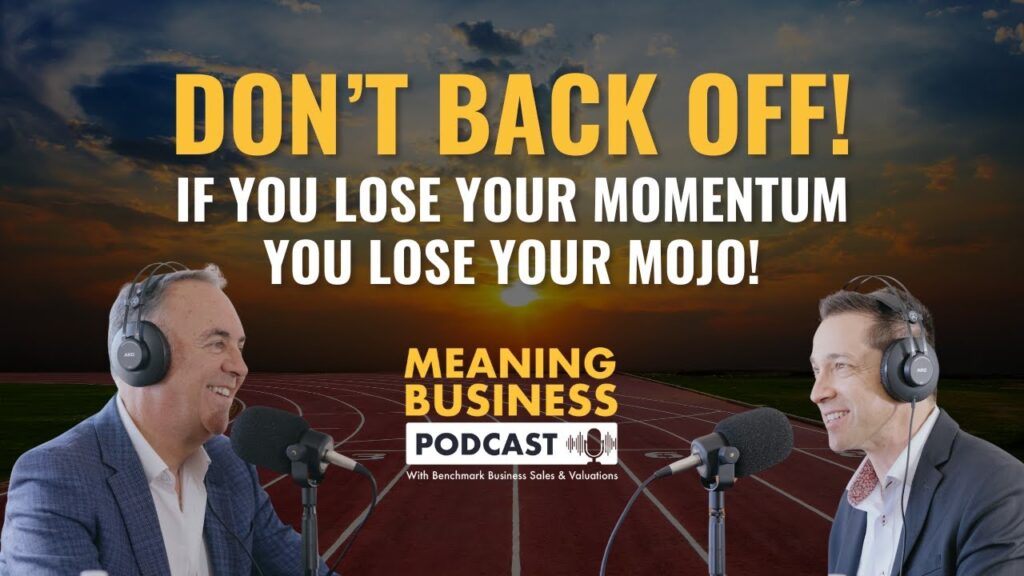
Momentum is not hype. It is business value.
A lot of business owners assume value comes from revenue, systems, or a strong product. Those things matter, but they’re not the whole story. The real driver that often separates businesses that keep winning from businesses that stall is simpler and more personal: sustained momentum.
Momentum is the force that keeps your business moving forward even after the early excitement fades. It is what turns effort into compounding results. When momentum is rising, progress feels natural. Decisions get made. Experiments happen. The team moves with more energy. Customers feel improvements. When momentum drops, the business doesn’t always collapse immediately, but it slowly loses edge, confidence, and “mojo”.
That is the core message in this episode of the Meaning Business Podcast: business success is not a one-off achievement. It is a continuous process of building, maintaining, and compounding momentum through steady improvement. And the moment an owner shifts from entrepreneurial drive into cruise mode, the business begins sliding backwards.
What business momentum actually looks like day to day
Business momentum is not motivation. It is not a single strategy. And it is definitely not a lucky season.
Momentum is what happens when progress becomes a pattern.
You see it in consistent execution, not stop-start bursts. You see it in decisions being made with clarity rather than delayed by overthinking. You see it in ongoing improvement rather than long periods of “we’ll fix that later.” It shows up in the team’s energy, because the team takes cues from leadership. It shows up in customer experience, because the business keeps removing friction and raising standards.
Most importantly, momentum is connected to value. When momentum is strong, your business is improving, adapting, and strengthening its position. That makes it more resilient and more valuable. When momentum is lost, value is destroyed because the business becomes less competitive, less sharp, and more dependent on the owner’s mood.
The quiet danger: declaring victory too early
One of the strongest metaphors from the episode is watching athletes celebrate before crossing the finish line, only to get overtaken at the last second. It is painful because it is avoidable. They were still in the race, but they acted like the race was done.
Business owners do a slower version of this. They hit a milestone, finally feel stable, and subconsciously decide, “We’ve made it.” They relax, not for a weekend, but for months. Sometimes for years. They stop pushing for improvement because the pressure has eased.
But cruise mode is not neutral. It feels comfortable, but it quietly costs you market position.
Your competitors do not slow down because you slowed down. Customers do not stop expecting more because you’re tired. Markets do not pause to reward your past effort. So while you’re cruising, other people are improving. And improvement compounds.
That is why so many owners wake up one day feeling confused: “How did we fall behind?” Most of the time, you didn’t fall behind suddenly. You simply stopped moving forward for long enough that the gap closed.
Why incremental improvement beats big reinvention
Owners often think momentum requires a dramatic transformation. A complete overhaul. A new strategy. A fresh brand. A big bang change.
Sometimes major change is necessary, but the episode points to a more reliable path: incremental improvement.
Small changes compound faster than most people realise. A 1% improvement in your systems, delivery, customer experience, or margins may not feel exciting, but repeated consistently, it becomes unstoppable. That is the logic behind Kaizen: continuous improvement through small, steady upgrades.
You can see this in long-term winners.
McDonald’s did not become dominant by perfecting one menu and stopping. It evolved slowly but relentlessly, improving operations, expanding offerings, adding new channels, and adapting to customer behaviour. It kept moving. The changes might have looked small in isolation, but over time they built a machine.
Porsche is another example of compounding through refinement. It doesn’t need to reinvent its identity every year. It improves product performance, engineering, and design in ways that add up over decades. That is momentum made visible.
The same principle applies to everyday businesses. The owner who commits to steady, disciplined improvement will beat the owner who only acts when forced by a crisis.
Momentum begins in the owner’s mindset, not the spreadsheet
One of the most important points in the episode is also the easiest to resist: momentum is primarily a leadership issue.
Yes, tactics matter. But mindset often decides whether tactics get executed at all.
When an owner stays in an entrepreneurial mindset, they stay curious. They keep testing. They keep learning. They are willing to experiment and handle setbacks without losing direction. When an owner slips into self-doubt or complacency, the business starts to wobble because action slows down.
The episode also introduces a useful way to think about this: the stories you tell yourself become your business reality. If you convince yourself you are losing traction, you start acting like you are losing traction. You reduce experimentation, avoid decisions, and become defensive. Over time, the business actually does lose traction, not because it was inevitable, but because leadership behaviour changed.
This is why “business mojo and motivation” isn’t fluffy. It influences decisions. And decisions influence results.
Your team cannot compensate for a flat leader
Many owners hope the team will carry momentum when the owner is tired or unsure. But teams take cues from leadership. When the owner’s energy is flat, urgency drops. When vision becomes unclear, accountability softens. When improvement stops being visible, the culture becomes passive.
A strong team is powerful, but a team cannot generate the owner’s belief for them. Momentum requires leadership that stays present. It requires a leader who remains committed to improvement even when they feel like cruising.
That doesn’t mean you need to be intense every day. It means you need a rhythm that keeps the business moving forward regardless of mood.
Why coaching and advisory support protects momentum
The episode makes a sharp observation: elite performers have coaches. Amateurs are the ones who say they don’t need one.
A good coach or advisor is not just about strategy. It is about psychology, accountability, and perspective.
When you are inside your business, your emotions can distort what is happening. A coach helps you zoom out. They help you stay committed when motivation drops. They challenge the narrative you’re telling yourself when it becomes unhelpful. They help you keep executing when you feel like pulling the throttle back.
This is also why advisory support becomes more valuable as the business grows. The stakes rise, and the cost of losing momentum for six months becomes enormous.
If you are thinking about working with Benchmark Business Advisory, the best framing isn’t “Do I need help?” It’s “What does it cost my business when I lose momentum and stop improving?”
Goals create forward pull, and forward pull creates momentum
Momentum needs a target. Without a clear goal, improvement becomes optional. And what becomes optional eventually disappears.
A powerful story in the episode comes from sport: when a new race date is locked in, mindset changes immediately. Habits return. Training becomes structured again. The goal creates forward pull.
Business is the same. When you have a clear growth target, a time-bound project, or an exit horizon, your brain stops drifting and starts moving. It becomes easier to make decisions because you know what you’re aiming at.
The episode recommends thinking in three plans, not one: a business plan, a marketing plan, and an exit or succession strategy. You don’t need these to be 80 pages. You need them to be clear enough to keep you moving forward. Combined with simple KPIs and external accountability, they create momentum that lasts beyond motivation.
How to maintain momentum in business without burning out
Maintaining momentum does not mean working harder forever. It means staying in motion on purpose.
A practical way to do that is to build a weekly rhythm of improvement. Not a once-a-year planning retreat. A weekly cadence that forces progress. It might be one bottleneck per week, one system improvement, one decision you’ve been avoiding, or one customer friction point you remove. The specifics will vary, but the rhythm is what matters.
Another key is reducing emotional decision-making. When you feel like momentum is fading, it’s easy to assume everything is wrong and start changing too much. Instead, anchor yourself in facts. What is working? What has improved? Where are the real leaks? Separating numbers from narratives protects your momentum, especially when confidence dips.
Finally, make improvement visible to your team. Momentum grows when progress is seen and felt. When your team can see that the business is moving forward, standards rise naturally. Energy lifts. The culture becomes improvement-oriented rather than comfort-oriented.
Key takeaways to carry into your week
Momentum is value. If you build it, you build a stronger business. If you protect it, you protect your competitive edge. If you lose it, you may not notice the damage immediately, but it shows up later as stagnation, lowered standards, and a business that feels heavier to run.
Cruise mode is one of the most dangerous phases for a business owner because it looks harmless while it quietly drains progress. The safest way to keep momentum is not dramatic transformation, but continuous improvement that compounds. And because momentum is deeply tied to leadership psychology, support systems like coaching, advisory, and accountability matter far more than most owners admit.
If you want the business to keep growing in value, treat improvement as a habit, not a project.
Conclusion: treat momentum like an asset, not a feeling
Business momentum is not something you either have or don’t have. It is something you build deliberately.
The question is not “Have we made it?” The question is “Are we still improving, or are we slowly giving our edge away?”
If this resonated, listen to the full episode, and then reflect on one simple prompt: Where have I started cruising, and what one improvement would restart forward motion this week?