

Your home, your business, your cash; none of these are your most important asset. For most business owners, the thing most worth protecting is the one they neglect the most: themselves.
Here is a question worth sitting with. If you owned a million-dollar racehorse, how would you treat it?
You would feed it a carefully controlled diet. You would exercise it every day. You would have a team of people grooming it, monitoring it, tracking its blood work and body composition. Vets would check it regularly. Every single aspect of that animal’s health would be managed with precision because the result it produces is only as good as the care it receives.
Now look in the mirror. How are you treating yourself?
If the honest answer involves skipping exercise, eating on the run, working through exhaustion, and telling yourself you will rest when things slow down, then you are managing your most valuable asset worse than most people manage their livestock.
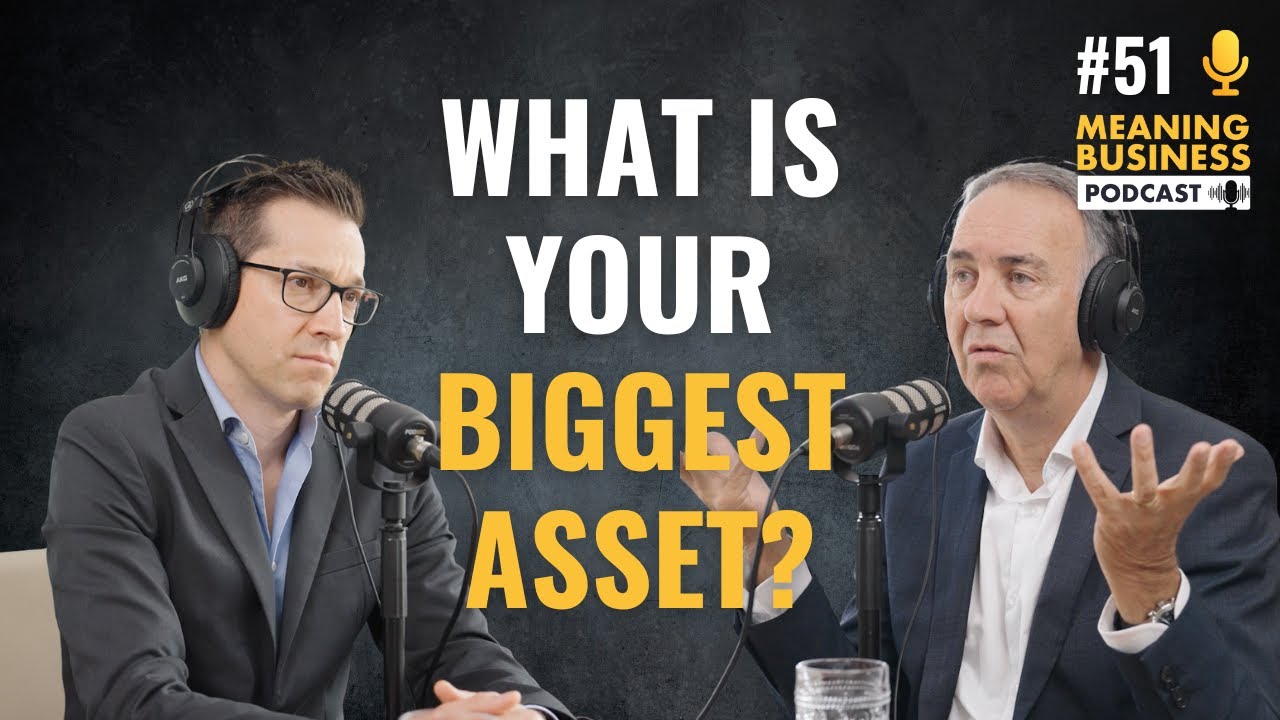
What Is Your Biggest Asset?
Most business owners get this wrong.
Ask most people what their biggest asset is and they will say their home. Ask a business owner and they might say the business. Some will point to the IP, the team, the stock, the contracts, or the cash in the bank.
These are all reasonable answers. And they are all wrong.
Peter and Bruce work through the logic carefully. For many small business owners, the family home is worth more in dollar terms than the business itself. A business worth one or two million sits below a home worth two or three million in most cases. But there are also business owners with operations worth twenty million, where the home is the smaller asset. So the answer depends on where you sit.
What matters more, though, is this: the business might not always be the most valuable asset on paper, but it is almost always the most strategically important one. It is the engine that pays the mortgage. It funds the lifestyle, the kids’ education, the superannuation, the holidays. Without the business generating income, many of those other assets disappear or lose their meaning.
So the business matters enormously. But the business is only as good as the person running it.
The Real Asset: It’s You
When Peter and Bruce strip it all back, the answer is straightforward. Look in a mirror. Line up yourself and any business partners or key stakeholders. What you see is your biggest asset.
The owner, or the leadership team, is the asset. Without someone providing vision, direction, and accountability, there is no business. There are just people doing tasks with no destination. The business survives on luck.
Bruce makes an important distinction here: if you are already the asset, you need to protect it. If you are not the asset, you need to become one. That means either adding genuine value to the business or being a better manager, a better leader, a better version of yourself. Either way, the path runs through you.
Think about the businesses most people regard as iconic. What would Virgin be without Richard Branson? What would Berkshire Hathaway look like without Warren Buffett? In many of the most recognised businesses in the world, the founder or leader is inseparable from the value of the enterprise. Remove that person and the business changes fundamentally.
The same is true in an SME. You are probably more central to your business than you realise. Which makes how you look after yourself one of the most important business decisions you make.
Energy, Focus, and Belief: The Three Things Business Actually Requires
Bruce puts it plainly. To do well in business, or in life, you need three things: energy, focus, and belief.
But here is the catch. Without energy, the other two do not matter. You can have crystal-clear focus on your goals and unshakeable belief in what you are building, but if you are running on empty you cannot execute. The tank is dry. Nothing moves.
This is why health is not a lifestyle choice that sits alongside your business strategy. It is the foundation of it. When you are sleeping well, eating well, and moving your body regularly, you think more clearly. You have more patience. You make better decisions under pressure. You show up for the people who depend on you in a way that simply is not possible when you are depleted.
Pete describes this with a specific example. While traveling for work, most people default to takeaway food because it is easy and fast. He chooses differently. Half a roast chicken, salad, avocado, nuts, seeds. Not because he was following a rigid programme, but because he knew that if he ate poorly he would feel poor for the rest of the trip. When you are already tired from travel, poor food choices compound the exhaustion. Small decisions about how you fuel yourself accumulate into how you perform.
The same principle applies to exercise. Pete typically trains six days a week. When people ask how he fits it in, his answer cuts through the usual excuses: you do not need an hour in the gym every session. In ten to fifteen minutes, with the right approach, you can get a meaningful result. Every hotel room has a chair. There is no excuse that holds up.
What Happens When You Neglect the Asset
Peter tells the story of a young entrepreneur he met at a networking event who had built one of the largest privately owned non-alcoholic beverage companies in the world. The origin of that business came from a crisis.
This person was traveling over 200 days a year for business. Attending events, networking at pubs and bars, drinking every night because that is the social fabric of business life at that pace. He realised he was heading somewhere bad. His health was suffering. He made a decision to stop, and in doing so, recognised a gap in the market that nobody had filled well. A major non-alcoholic beverage business grew from the moment he decided to look after himself.
The story lands on something important. The decision to protect your health does not just keep you going. Sometimes it opens up perspectives and opportunities that the depleted version of you simply cannot see.
Peter also reflects on something he noticed at a networking event of his own. The number of men in their 30s and 40s who looked visibly unwell. Beer guts. Tired eyes. The wear of years of not looking after themselves, showing up in their faces and bodies at an age where it should not be there yet. It is not about aesthetics. It is about the trajectory those choices are pointing toward.
Two Identical Businesses: Who Would You Back?
Here is the comparison Bruce lays out, and it is worth taking seriously.
Imagine you are considering investing in two businesses. Same turnover. Same history. Same growth potential. Everything about the financials is identical.
The difference is the people at the top.
The first CEO is fit, healthy, and vital. Sharp. Energetic. Clearly taking care of themselves.
The second CEO is equally passionate about the business but is eating junk food, drinking heavily, working around the clock, and looks like a walking health risk.
Which business would you back?
The answer is obvious. And not just because of the actuarial risk of the second scenario. The fit CEO is influencing the culture of the business around them. When the person at the top takes their health seriously, it ripples outward. The team starts to reflect it. The standards shift. The energy in the business changes.
Culture flows from the head. And the head is you.
Health Creates Culture: In Business and at Home
Bruce and Peter both land on this point: what you model in your behaviour becomes the culture of the people around you.
In Peter’s family, the parents exercise. The kids see that. They play football. They are active. It is not a rule written on a whiteboard. It is just what the family does, because it is what the parents do. Culture is not announced. It is demonstrated.
The same mechanism operates in business. If you as the leader are healthy, focused, and energetic, your team starts to reflect that. If you are burnt out, reactive, and perpetually exhausted, that becomes the culture too.
Bruce makes the point about standards. The culture of any organisation, or any family, is a direct result of what the leader will and will not accept. Set a standard for yourself — whether that is a weight target, a daily movement practice, or simply no phones at the dinner table — and that standard creates the behaviour, which creates the culture.
Bruce uses the phone bowl at his dinner table as an example. All phones go in. No exceptions. That is the standard. It creates something real: a family that actually talks to each other. The same logic applies to how you look after yourself. Define the standard. Live it. Watch it spread.
Strategic Selfishness: Why Looking After Yourself Is the Right Business Move
There is a word that comes up in this conversation that stops some business owners in their tracks: selfish.
Pete argues that looking after yourself requires a degree of strategic selfishness. Taking a day off. Going to play golf or tennis when the business could technically use your presence. Saying no to something so you can protect your energy. Delegating because you have chosen to be the leader who commands from above rather than the one stuck in the trenches doing everything.
He frames it clearly. This is one of the rare situations in life where being selfish is the right choice. Not because you do not care about others, but precisely because you do. Your family needs you present and energetic. Your team needs a strong leader. Your business needs a clear thinker at the top. None of those things happen if you are constantly depleted and doing everything yourself.
And there is a practical business benefit. When you are genuinely well looked after, you become a better delegator. You trust your team more. You are less anxious about what happens if you step away. The business becomes less dependent on you, which makes it more valuable, more sustainable, and frankly more enjoyable to run.
The goal is not a business that cannot function without you. The goal is a business that runs well precisely because you have the perspective and the energy to lead it properly. If you are thinking about what building a truly valuable business looks like, this is part of the foundation. A leader who is healthy, present, and thinking clearly is not a lifestyle bonus. It is a competitive advantage.
How to Actually Do It: Practical Steps From the Episode
The conversation does not stay in theory. Bruce and Peter are specific about what protecting your greatest asset looks like in practice.
On exercise: you do not need an hour. Ten or fifteen minutes of focused movement is meaningful. Bruce mentions a fitness app that takes your weight and height, gives you structured exercises you can do with a chair, and covers diet and sleep advice too. It works in a hotel room. It works anywhere. The point is that you remove the excuse of not having time or equipment.
On food: the choices you make while traveling are the real test. Pete chose real food — a roast chicken, salad, avocado — over something fast and easy. The discipline is not about restriction. It is about knowing that how you fuel yourself determines how you function.
On hobbies: both Peter and Bruce are emphatic that having passions outside of business is not a distraction from success. It is a requirement for it. For Bruce, going to cars and coffee is something he genuinely looks forward to. For Peter, it is being present at his kids’ football training and school events. These things are not peripheral. They are what keeps the engine of the business running, because they keep the person behind the engine grounded, motivated, and well.
And when the tough periods come in business — which they always do — having other sources of meaning and other people around you is what allows you to ride through rather than fall apart.
Key Takeaways for SME Owners
- Your greatest asset is you. Not the balance sheet. Not the property. Not the cash. The owner, or the leadership team, drives everything else. Protect that asset accordingly.
- Business needs energy first. Energy, focus, and belief are the three essentials. But without energy, the other two mean nothing. Health is the foundation of business performance, not a nice addition to it.
- How you treat yourself shapes your culture. What you model in your behaviour becomes the standard for your team and your family. A healthy, energetic leader creates a healthy, energetic culture.
- Small, consistent actions add up. Five to ten minutes of exercise. One better food choice. No phones at the dinner table. These are not dramatic changes. They compound over time into a very different quality of life and a very different quality of leadership.
- Hobbies and passions outside of business are not optional. They sustain you through the hard periods and keep you sharp during the good ones. Make time for them without guilt.
- Strategic selfishness is allowed. Taking a day off, delegating, protecting your energy — these are not acts of self-indulgence. They are acts of leadership. Your family and your team need the best version of you, and that version needs to be cared for.
- The comparison is stark. Two identical businesses. One healthy CEO, one not. The healthy one wins every time, for reasons that go beyond the individual and flow through the entire culture of the business.
We spend our careers building assets: the business, the property, the portfolio, the superannuation.
But the asset that makes all of those possible, the one sitting behind every decision, every hire, every sale, every hard conversation and every good year, is you.
Treat yourself like the million-dollar racehorse.
Because you are worth a great deal more than that, and the people around you need you to act like it.