

You can be highly profitable and getting poorer at the same time. Here’s why profit alone doesn’t determine what your business is worth, and how to build both.
Imagine you’re a farmer chasing the harvest. You strip the soil, skip maintenance on the fences and machinery, and push the land hard for maximum yield. This year, you make maximum money. But do it year on year and the yield slowly shrinks, and the value of the farm itself falls away underneath you.
Now flip it. You pour everything into the machinery and the land, constantly investing in the things that drive value, but you never focus on the yield. Eventually you run out of money, because all your cash is tied up in the value side and there’s no harvest paying the bills.
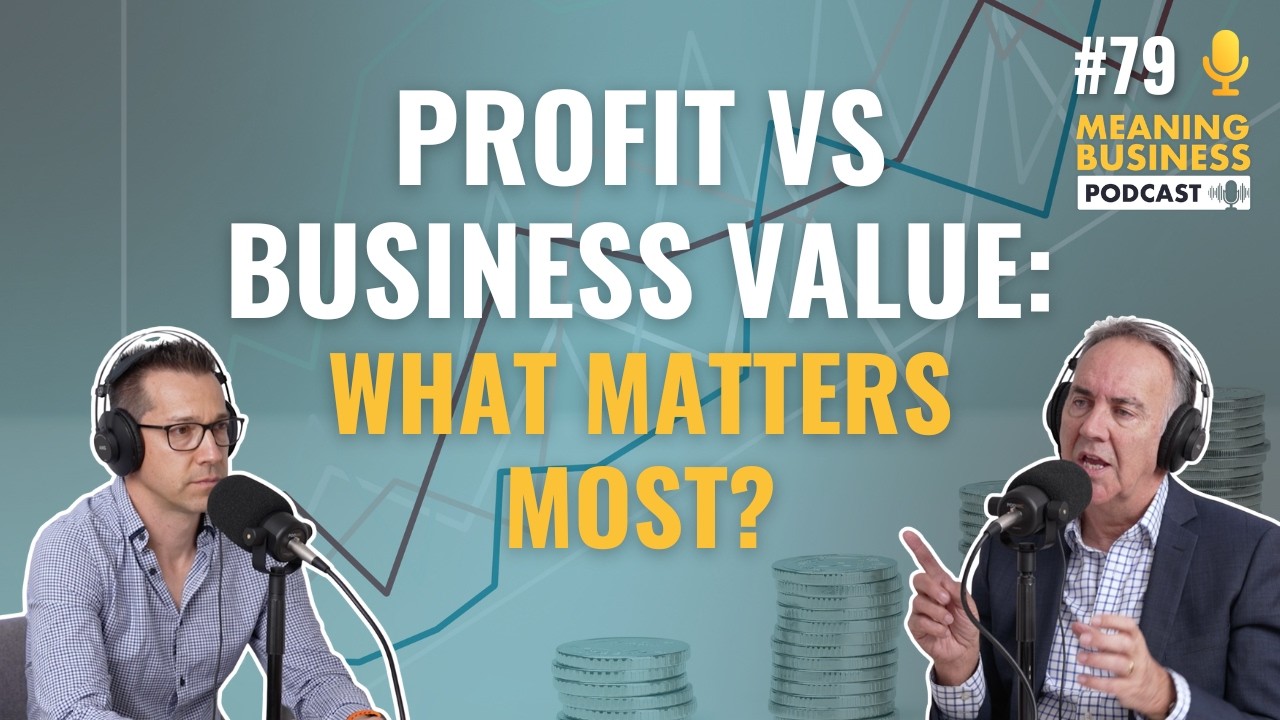
That’s the tension at the heart of Episode 79 of the Meaning Business Podcast, where Peter and Bruce dig into one of the most misunderstood questions in business: should you focus on profit or business value? As Peter put it with his farming analogy, you can be profitable and getting poorer at the same time, or unprofitable and actually getting richer.
If you own a business, the answer matters more than you might think, because the way you resolve it shapes every investment decision you make.
Is Profit the Same as Business Value?
No. Profit is one input into business value, but it is not the same thing. As Bruce explained, business value is profit multiplied by a multiplier, and everyone focuses on the profit side of that equation while forgetting the multiplier can be just as powerful.
Bruce’s way of putting it: value equals fact by opinion. The profit is the fact. The multiplier is the opinion, and that opinion is formed by everything else going on in your business.
He gave a simple example. Say you run a truck transport business. You bought the truck new, it now has 3 million kilometres on it, and you’ve made a lot of money along the way. You go to sell the business, but the truck’s not worth anything. The profit was real. The value isn’t there.
Some owners deliberately extract maximum profit and walk away with nothing left to sell, and that’s a legitimate choice if you make it with your eyes open. Others go the opposite way. Peter pointed to Amazon, which for many years was not profitable, partly because of its reinvestment strategy, constantly pushing money back into building value. Bruce raised SpaceX as a current example: an entire space industry that hasn’t really made money yet, but with a payoff expected in the future that has everyone wanting to jump on board.
The point for small and medium business owners is that the same dynamic plays out at your level. Are you lining your pockets, or building something a buyer will pay for? Ideally, you’re doing both.
The Three Ways You Make Money From a Business
Bruce laid out a framework worth writing down. There are three ways you make money out of a business:
- The wage you pay yourself
- The profit the business earns (dividends)
- The value you receive when you sell
Most owners obsess over the second, expect the first, and forget the third entirely. But the third one can be the biggest payday of your life, and it’s the one you have to build towards deliberately.
Bruce was clear on the order of operations. Rule number one: you need profit to be viable. Profit is cash in the bank. Rule number two: pay yourself a wage, because if you’re not getting a wage, you might as well go and get a job. Then, once you’ve got the profit and the wage sorted, the business value is the ultimate goal you should always be conscious of, even from day one.
The problem, as Peter and Bruce discussed, is that owners chase profit so hard they lose sight of being ready to exit at any point in time. And exit readiness isn’t just about the dollars.
Why You Should Always Know What Your Business Is Worth
Being sale ready is as much about mindset as money. Bruce shared that sometimes owners say they want to sell, then when an offer actually lands, they hesitate. Sometimes a strategic acquirer comes knocking and the owner won’t sell simply because they’ve never thought it through.
Bruce told the story of a business owner he spoke to in Western Australia, a great operator who ran a massive business. Every day, this owner updated a spreadsheet calculating what his business was worth, so he always knew his number. One day, someone tapped him on the shoulder and said they wanted to buy the business. He told them exactly what it was worth, and they paid it. After settlement, the buyers admitted they would have paid a lot more.
There are two lessons in that story. First, as Bruce noted, let the other side speak first. Second, and more importantly, this operator ran his business to make profit, paid himself a wage, and never lost sight of the third way to make money: the sale. Knowing your number at any point in time should be part of your business plan. What’s my business worth today, and where do I want it to be in three or five years?
What Actually Determines Your Valuation Multiple?
The multiple is determined by the risk and quality factors a buyer sees beyond the profit line. Bruce posed a scenario: two businesses in the same town, both making glass and aluminium windows, both earning exactly the same profit. Are they worth the same money? No.
The difference comes down to the factors that form the buyer’s opinion, including:
- Reliance on the owner. A business that runs without the owner is worth more than one that depends heavily on them.
- Working capital. The business that needs less working capital to operate is worth more.
- Stock levels. Carrying less stock to operate lifts the value.
- The team. Happy staff, quality people, and solid employment contracts all add value. Bruce made the point that a sticky team can even attract a premium, because a buyer who has tried and failed to poach your people may simply decide to buy the whole business to get them.
- Revenue trend. A revenue line going up is worth more than one flatlining or going down.
- Contracts, growth trajectory and risk factors. The quality of your customer contracts and your long-term outlook all feed the multiple.
And here’s why this matters so much. The multiple is applied to every dollar of profit you make. As the hosts explained, for every extra dollar of profit you earn, you could be adding three dollars to the value of your business if your multiple is around three. Every 0.1 gain in your multiple can translate to hundreds of thousands of dollars. Peter put rough numbers around it: on a business valued around a million dollars at a multiple of two, lifting that multiple by half a turn puts an extra half a million dollars in your pocket. The numbers add up very quickly.
This is exactly the kind of work building a valuable business involves: not just growing profit, but deliberately improving the factors that lift your multiple.
Can Hiring a Manager Increase Your Business Value?
Yes, even though it reduces your profit on paper. This is where a pure numbers view of your business can steer you wrong.
Peter explained the trap. If you only have a profit focus, you resist putting on a manager because it’s going to cost $150,000 a year, or you tell yourself you can do the job. Looked at purely through an accounting lens, hiring that manager means giving up $150,000 to $200,000 of profit. Why would you do it?
Because of what happens to the multiple. Peter walked through the shift: an owner-operated business might be worth around two to two and a half times profit. Put a manager in, and suddenly buyers look at it through an investment lens, a very different lens, and you’re talking three to four times. The manager might even pay for themselves by implementing efficiencies. Meanwhile, you’ve stepped out of the day-to-day, you’ve got a management structure doing the doing, and you’ve become a real business owner. You might even be able to take holidays.
Peter also made a sharper point: a profit-only focus can paradoxically hold you back. If all you’re thinking is maximum, maximum, maximum, you won’t invest in the right staff, and you end up building a business that’s completely reliant on you, which is exactly what drags your valuation down.
This is also where Peter took issue with how owners use the accounting space. Not the accountants themselves, but the habit of going to your accountant to improve the business and only ever working the financial levers. The numbers are part and parcel, but what about the non-financial side? You’ve got four key employees. What do their contracts look like? Are they happy? Those factors dictate whether the business is valuable, sellable and attractive to an investor, and they don’t show up in a P&L.
Should You Focus on Profit or Value? The Answer Is Both
You need to focus on both, and the balance is situational. That was where Peter and Bruce landed, with one qualifier from Bruce: profit first, value second, because without profit there is no value.
Peter explained that the right emphasis depends on the stage of your business and your own life cycle as an owner. If you’ve got another five years in the tank and you’re earning a comfortable income, reinvesting and accepting lower profit may make sense, because you’re building value for five years’ time. But if you’re six months, twelve months or two years out from selling, the emphasis flips: you need to be showing profitability. In fact, Peter suggested that from about three years out, you want to be showing increasing profitability and strengthening the numbers to justify a higher valuation. That’s the core of getting sale ready.
There’s a personal discipline side to this too. Peter observed that as success comes, some owners fall back on ego. Good profit arrives and it goes on a Porsche and a splurge rather than a modest pay rise or a dividend, with the real prize kept in view: build a valuable business, exit for a serious number, and then truly play with your money.
And even when you’re deliberately trading profit for value, it should be through investment with an expected return. You might flatline for a while, but the expectation is an uplift on the other side.
How Acquisitions Can Grow Your Business Value
Buying another business can restore or grow your value faster than almost anything else. Bruce shared a story about a large coffee roasting company in Victoria from quite a few years ago. The business was making an EBIT of $8 million a year and wanted to sell for four times EBIT. Then it had a downturn, and in round numbers the EBIT dropped to $7 million. At four times, the business went from being worth $32 million to $28 million.
So what did they do? They acquired a small company for about $400,000, consolidated the revenue without taking on any overheads, and got the business back up to $8 million EBIT. The value was restored, for a $400,000 outlay.
Bruce and Peter agreed acquisition is one of the quickest ways to grow, almost instant, though there’s work involved and many moving parts. Peter noted it’s a legitimate growth strategy that isn’t talked about enough in the small and medium business world. Bruce added a practical angle for anyone in mining services, contracting or building services, where staff are hard to find: one of the best ways to get staff is to buy another company and bring the team in. Just do it the right way.
The bigger principle, as Bruce framed it, is that taking yourself out of the business is the first step, and finding opportunities to grow through acquisition is the next. First you work on the business rather than in it, then you use it as a platform.
Key Takeaways for SME Owners
- Profit and value are not the same thing. Business value is profit multiplied by a multiple, and the multiple can matter as much as the profit.
- Value equals fact by opinion. The profit is the fact. The buyer’s opinion of your risk, team, contracts and owner reliance sets the multiple.
- There are three ways to make money from a business. The profit you earn, the wage you pay yourself, and the value when you sell. Don’t forget the third one.
- Profit comes first, value second. Without profit there is no value, so get viable and pay yourself a wage before chasing the multiple.
- Owner reliance drags your valuation down. Putting a manager in can lift a business from roughly two to two and a half times profit to three to four times, even after the salary cost.
- Be mentally ready to exit at any time. Know what your business is worth today, and from about three years out from a sale, focus on showing increasing profitability.
- Acquisitions are an underused value lever. Buying a business can consolidate profit, restore value and even solve staffing shortages.
Frequently Asked Questions
Does profit determine the value of a business?
Only partly. Business value is calculated as profit multiplied by a multiple, so profit matters, but the multiple is shaped by other factors such as owner reliance, working capital, stock levels, staff quality, contracts and revenue trend. Two businesses with identical profit can be worth very different amounts because of these factors.
Can a business be profitable but not valuable?
Yes. A business can generate strong profit while its underlying value declines, like a farm being pushed for maximum harvest while the land degrades, or a transport business making money from a truck that’s now worthless with 3 million kilometres on it. Extracting maximum profit with nothing left to sell is a valid choice, but only if you make it knowingly.
How do business valuation multiples work?
A buyer applies a multiple to your profit to arrive at a value, and that multiple reflects their opinion of your business’s risk and quality. For every extra dollar of profit, a multiple of three adds three dollars of value, and even a 0.1 improvement in your multiple can be worth hundreds of thousands of dollars.
Does hiring a manager increase business value?
Yes, in many cases. An owner-operated business might sell for around two to two and a half times profit, while a business with a manager in place can attract three to four times, because buyers view it through an investment lens. The manager’s salary reduces profit on paper, but the uplift in the multiple can far outweigh the cost.
When should I start preparing my business for sale?
Ideally from day one, by building the business with an exit in mind, and practically from about three years out. In the final three years before a sale, you want to show increasing profitability and strengthening numbers to justify a higher valuation, and you should know what your business is worth at any point in time.
Is buying another business a good way to grow value?
Yes, it’s one of the quickest ways to grow. One Victorian coffee roasting company restored roughly $4 million of lost business value by acquiring a small company for about $400,000 and consolidating the revenue without adding overheads. Acquisitions can also solve staff shortages in industries like mining services, contracting and building services.
Profit is the fact. Value is the opinion. The owners who win are the ones who work on both: banking the profit today while quietly building a business someone else would pay a premium for tomorrow. Know your number, stay ready to sell, and never confuse a good harvest with a good farm.
Topics: profit vs business value | business valuation | business valuation multiples | what is my business worth | how to increase business value | business value drivers | owner dependence | sale ready business | exit strategy | selling a business Australia | business growth through acquisition | EBIT multiple | SME business advice | business advisory Australia | working on the business not in it | Meaning Business Podcast | Benchmark Business Advisory